GET THE LATEST UPDATES RELATED TO TECHNOLOGY FROM THE FAMOUS WEB AND MEDIA NETWORKS LIKE NDTV, GADGET 360, GSM ARENA TOGETHER AT THIS SITE TECHNICAL DEPICTS CREATED BY ROVE REVIEWS.
When You dont have any way out the you are misleaden Thousands of students want to learn programming theybwant to make it their passion but the cannot utilise it You have resources but you are on the world of outputs so make use of what ever you have.
The 2022 Oscars — or the 94th Academy Awards — are slated to take place Sunday, March 27 at the Dolby Theatre in Los Angeles. For Indian viewers, the ceremony will happen live on Monday, March 28, at 5am IST. Excited viewers in India can watch the Oscars live on Disney+ Hotstar.
Here's the brand new Nissan Ariya, the car we've been seeing for a while now, either in tempting mock-up publicity shots or as a static display at car shows. Now it's driveable and the really good news is it's almost ready to hit the road.
Reservations are already being taken for the Ariya and deliveries are expected to begin by the summer. TechRadar recently had a chance to drive a pre-production version of the car, which is being billed as a coupe crossover SUV by Nissan.
It's all-electric, has five doors and plenty of smart technology that you'd expect from the innovative Japanese automaker. So, what's it like behind the wheel of this £41k and up EV?
We got to find out at Circuito del Jarama, the former F1 racetrack just north of Madrid. Nissan had hired the circuit and subsequently created its own smaller route using myriad bollards.
The idea was to give us a variety of driving scenarios emulating everyday road conditions. A big difference though is a racetrack is super smooth, so the effect wasn't quite the same as driving along rutted and potholed roads. Nevertheless, the Nissan Ariya proved to be every bit as impressive as it looks.
Striking and well equipped
(Image credit: TechRadar / Rob Clymo)
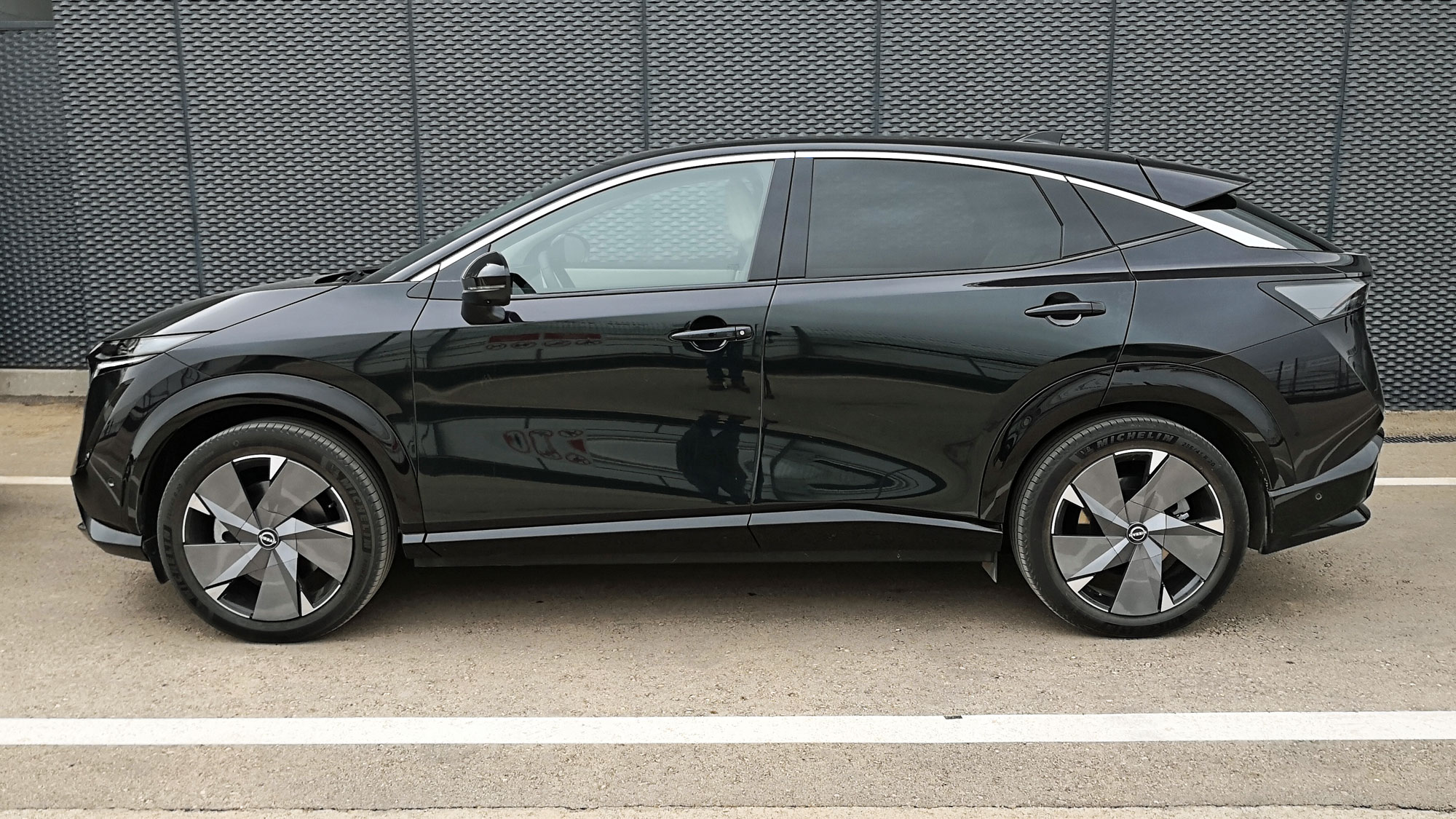
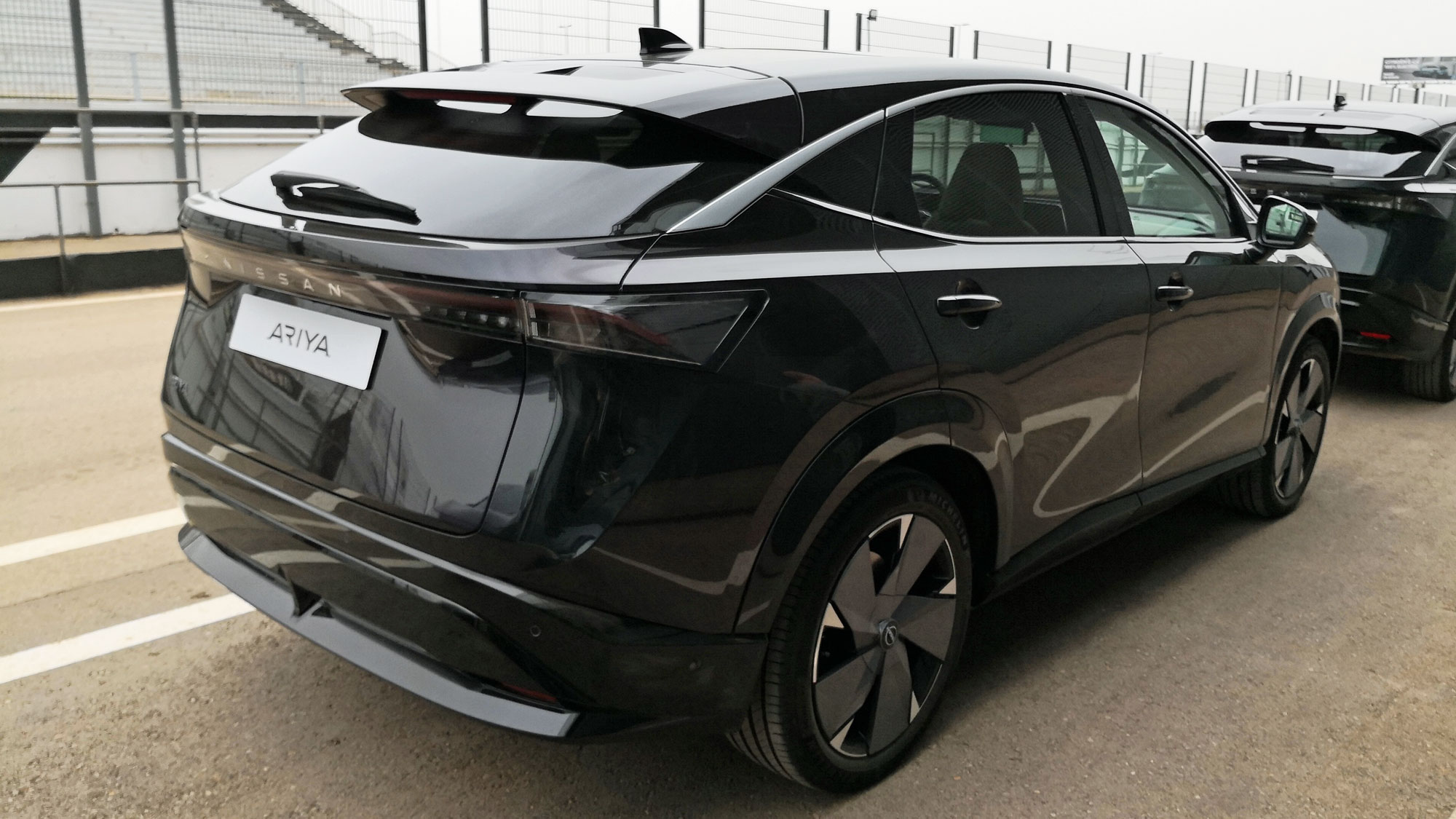
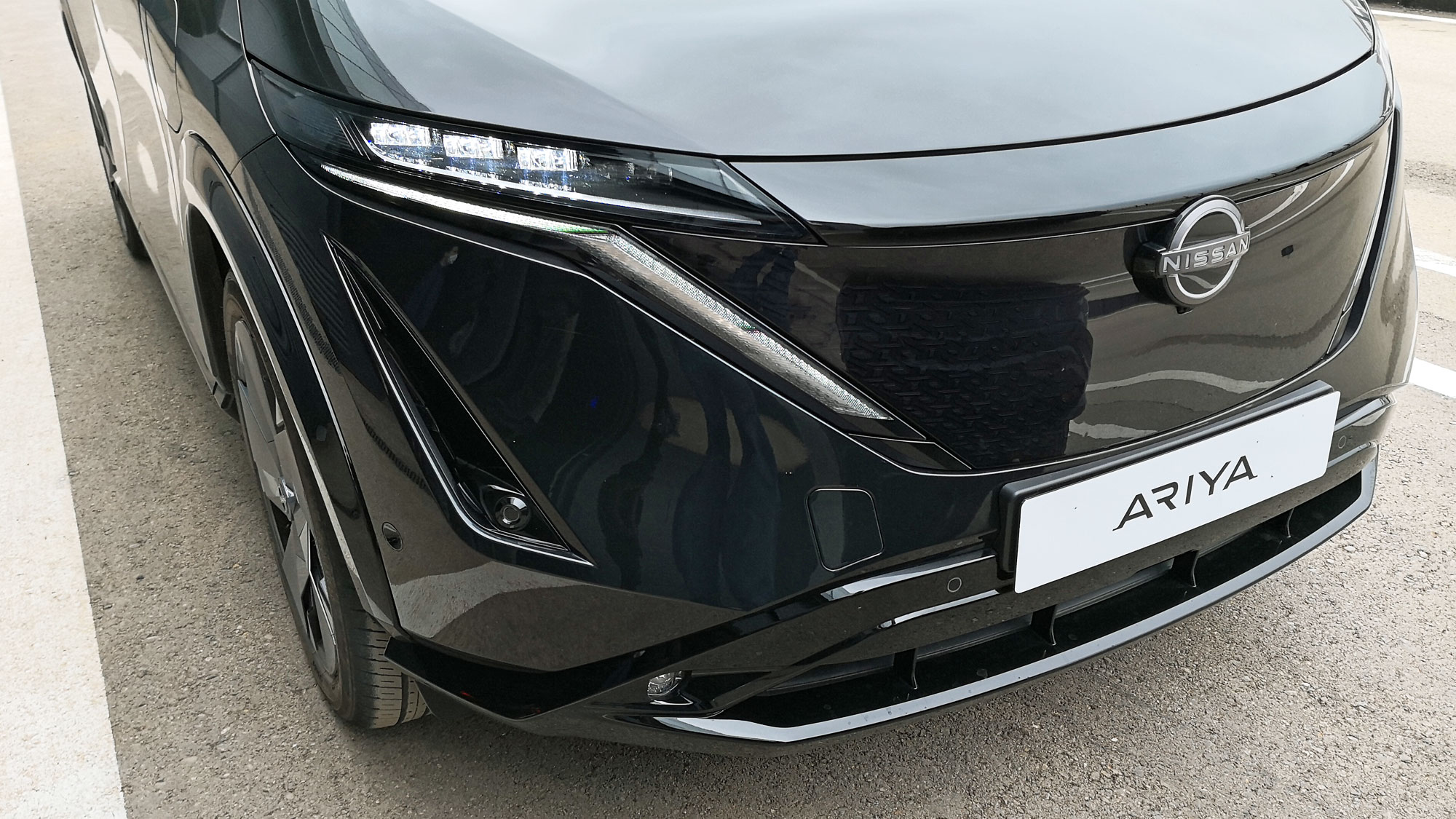
Indeed, the car is quite striking, especially from the front. It was good to see the Ariya in another color than the gold we've been seeing in all those publicity shots over the last couple of years or so.
TechRadar got to drive a dark colored model, which looked to be a very dark metallic green on closer inspection, though appeared black on first sight. The white examples looked pretty good too, but Nissan is offering the Ariya in a range of ten body colors. A trio of dashboard colors (black, blue and grey) will help to bling things up a bit more on the inside.
There'll be four versions of the Nissan Ariya heading for the UK market, with prices starting from £41,845. These include the Advance with a 63kWh battery, then the Evolve, the e-4ORCE Evolve and e-4ORCE Performance editions, which all feature a larger 87kWh battery. The top-of-the range e-4ORCE Performance 87kWh model is set to cost £58,440.
However, that will also get you all the trimmings including a 10-speaker Bose sound system, digital head-up display, intelligent rear view mirror, electric panoramic sunroof, 20-inch alloys with aero covers and Blue Nappa leather seat fronts.
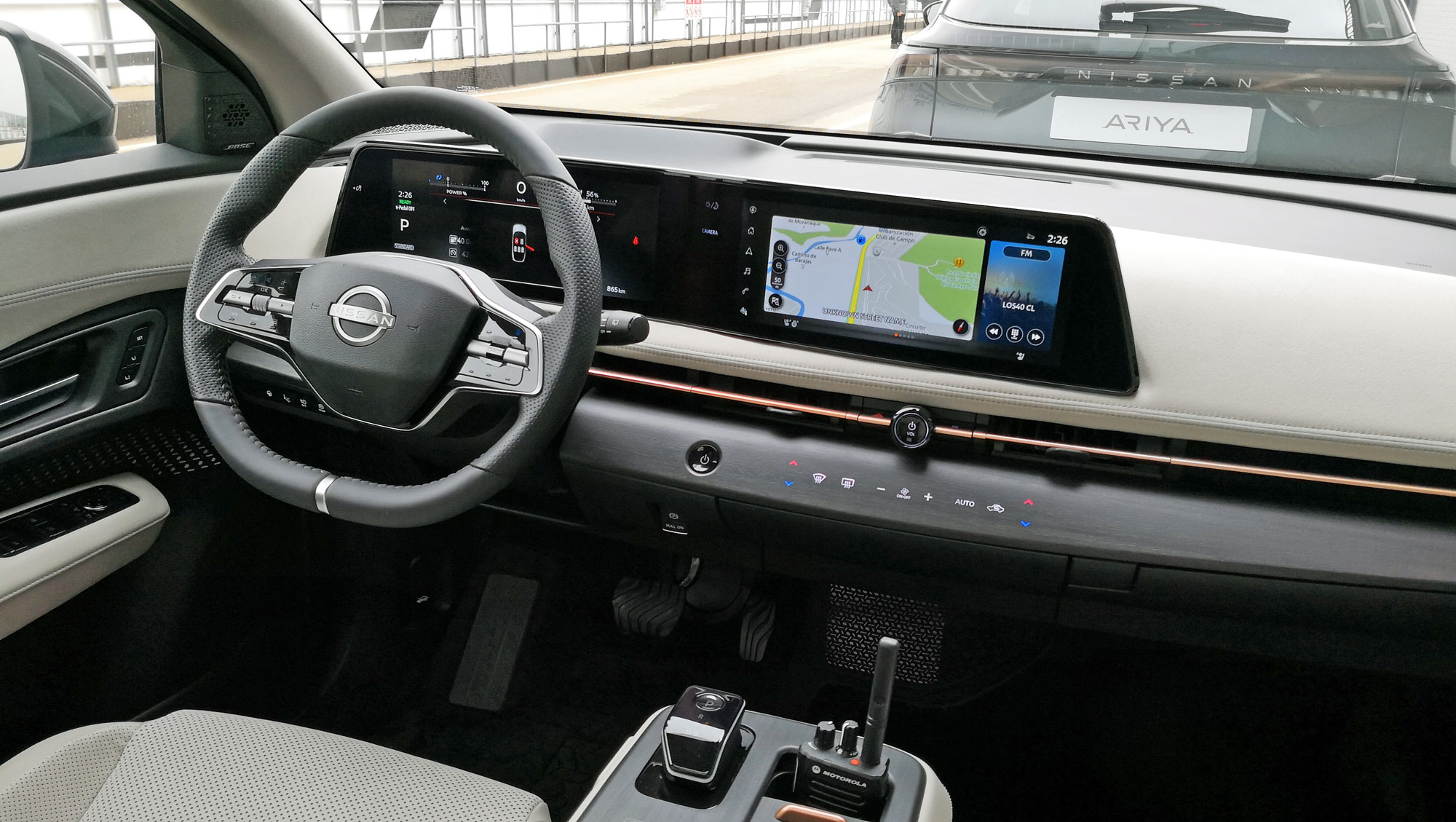
The interior of the model we drive, meanwhile, was an impressive blend of white seats and trim highlights with cool styling touches, like the Japanese-flavored patterns in locations like the door panels and around the speakers on each of the doors.
The theme continues in other subtle areas throughout the interior. A panoramic glass sunroof topped it all off.
It's a pleasure to drive
(Image credit: TechRadar / Rob Clymo)
Like most new EVs the Nissan Ariya is a both a doddle and a pleasure to drive. Everything's electric, so you can get the seat and steering column into a position that suits and you're ready for the off.
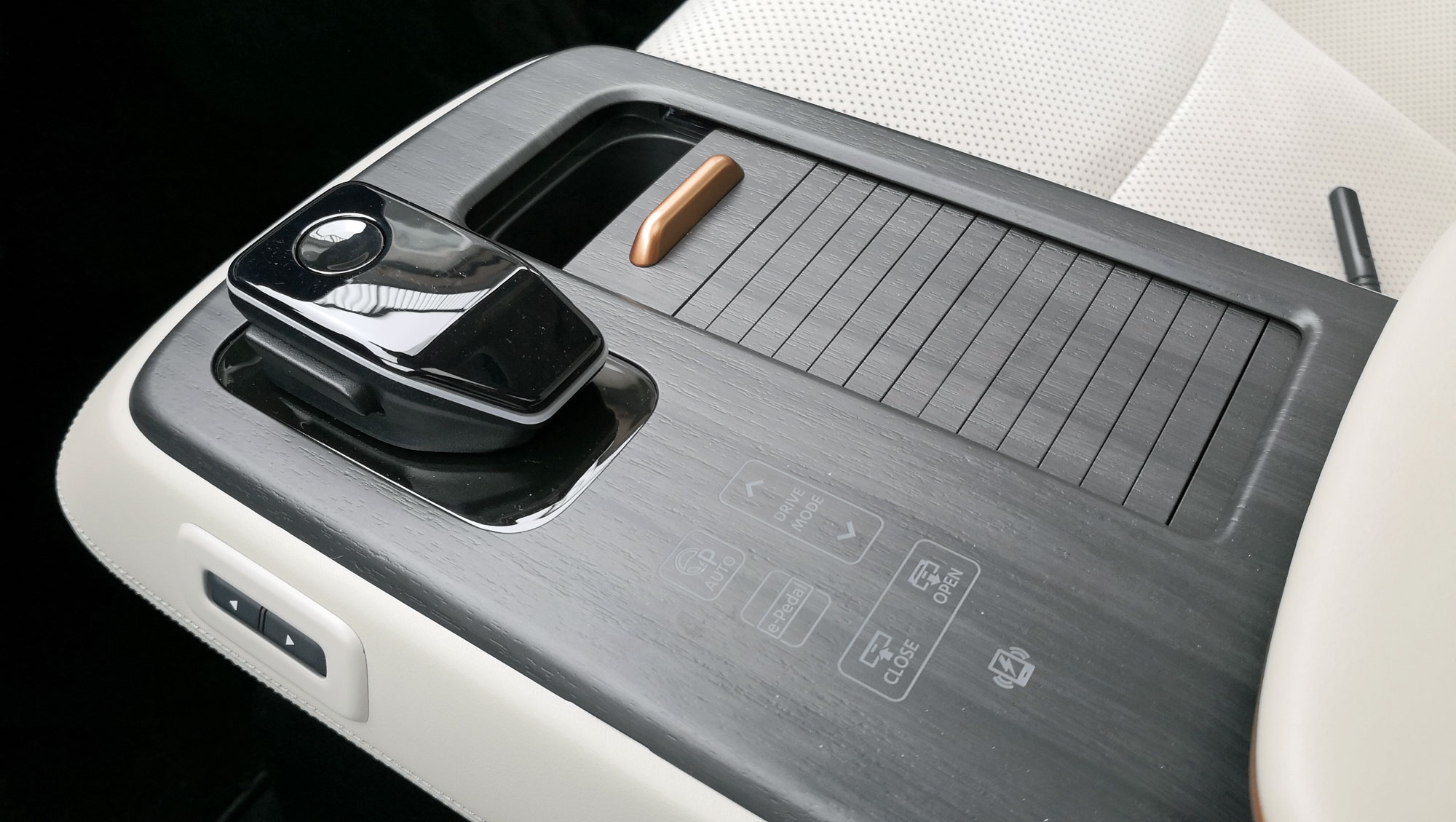
Drive modes (Eco, Normal and Sport) are selected from the centrally mounted lever, which sits on top of a large binnacle that also carries push button options for engaging Nissan's addictive e-Pedal as found in the Leaf. This console can be moved backwards and forwards too using a couple of arrow buttons, allowing you to set a position of comfort that suits.
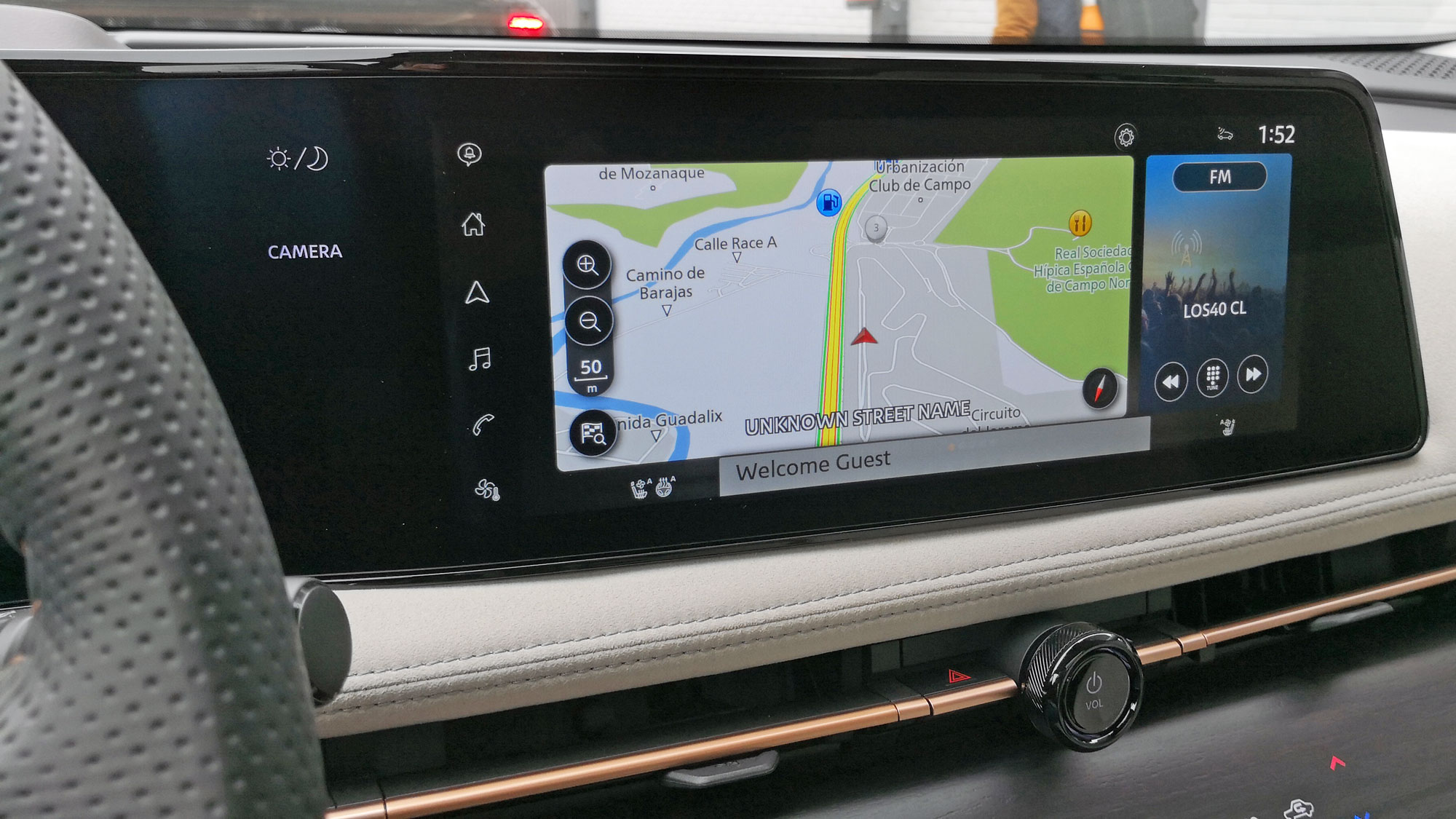
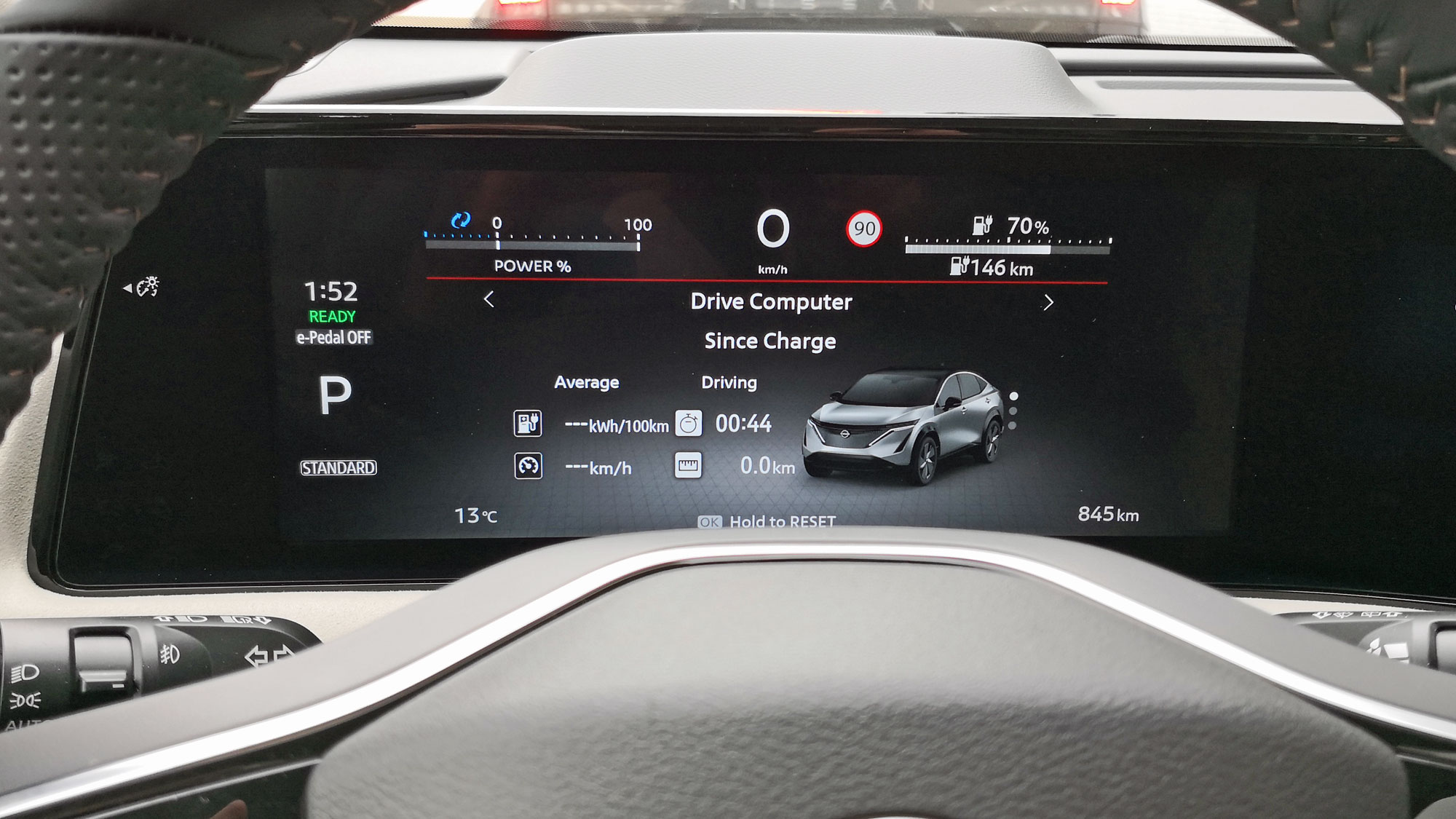
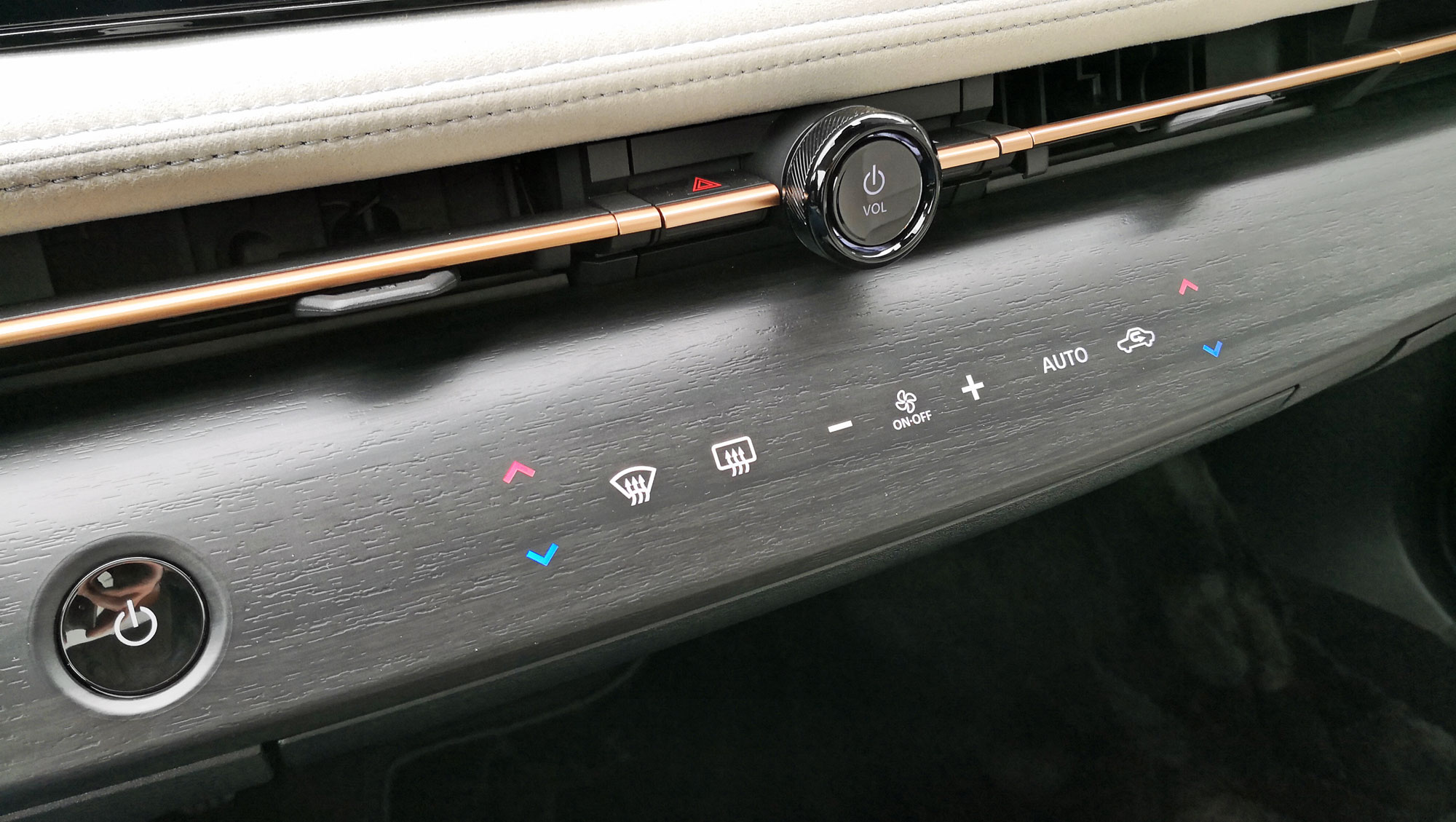
Twin 12.3-inch HD screens dominate the dash area, without being too intrusive. Our car also had a head-up display. We didn't get much time to take a deep dive into the infotainment options or pick our way through the sub-menus like we’d normally do in a proper review. However, the general layout, which is supplemented by some manual controls along the dash looks to be saying all the right things.
Image 1 of 4
(Image credit: TechRadar / Rob Clymo)
Image 2 of 4
(Image credit: TechRadar / Rob Clymo)
Image 3 of 4
(Image credit: TechRadar / Rob Clymo)
Image 4 of 4
(Image credit: TechRadar / Rob Clymo)
Drivetime was reasonably short too, being limited to a handful of laps in convoy fashion around the makeshift road layout, so there was no overtaking either. That said, and this being a track, it was hard not to push the car a bit. Nissan had carved up the circuit into different speed sections too, emulating typical speed limits.
The Ariya is quite a big car and feels like it when you're putting on the power through tight bends. What you gain in head room from the height of the car you lose a bit in the corners. Again though, this is probably less noticeable driving on 'real' roads.
The effect should also be minimized somewhat if you're driving an e-4ORCE model. Nissan's new technology is designed to monitor and automatically control power output and braking, helping to deliver a more dynamic driving experience to those looking for it.
(Image credit: TechRadar / Rob Clymo)
In fact, the dual-motor, four-wheel drive version of the Ariya looks like being the best if you're aiming for a more energetic drive with its nigh-on 50/50 weight distribution.
It's quite potent too, with 0-62 mph arriving in a mere 5.1 seconds under Sport mode. The front wheel drive 87kWh version does it in 7.6 seconds.
The Ariya cruised effortlessly along the straight sections though and felt agile enough for most needs. The view out the back is rather limited due to the shape of the roof, rear window and proliferation of headrests. No matter, as Nissan has packed in driver aids aplenty including its ProPilot parking tools to help you along the way.
And, talking of neat tricks, Nissan's e-Pedal is also present and its addictive one-foot-to-drive setup is as much fun to use in the Ariya as it is in the Leaf. Overall, our five laps showed much promise and left us wanting more.
In terms of range, WLTP figures released by Nissan shown an estimated distance of up to 223 miles for the 63kWh Ariya, up to 310 miles for the 87kWh version and around 285 miles for the 87kWh all-wheel-drive 4-e4ORCE edition.
That drops slightly to 248 miles for the 87kWh performance model. All cars use CCS charging for the European market.
There's more to come
(Image credit: TechRadar / Rob Clymo)
The new Nissan Ariya is just one part of the Japanese automaker's plan for an electrified future, although its EV roots lie firmly in the past. Let's not forget Nissan launched the original Leaf compact EV way back in 2010.
In the 12 years since, Nissan has sold a whopping 577,000 Leaf vehicles, which is a pretty decent number by anyone's standards.
The company now has plans for five new electrified vehicles, which involves a collaboration between all three brands that make up the Renault, Nissan and Mitsubishi alliance.
Part of that plan is to make use of both Lithium-ion and solid-state battery technology. In a bid to be leaner, the business is working towards cobalt-free batteries and reducing costs for Lithium-ion power packs by over 65% by the year 2028.
There are also plans for a pilot plant in Yokohama, Japan, which is due to open in 2024 with the aim of developing solid-state batteries for inclusion in production vehicles by 2028. It's just part of a huge €15.6 billion investment over the course of the next five years. Ultimately, Nissan wants 75% of its sales to be electric vehicles by 2026 and hopes to be selling 100% EVs by 2030.
During the Nissan Electrified event we got to see other models that form part of the masterplan. There was, of course, the Leaf. Also present were latest incarnations of the Juke, which has been given hybrid treatment and Nissan's hugely popular Qashqai, which gets the benefit of e-Power as does the Nissan X-Trail too.
Nissan was also keen to underline how valuable its brand new Townstar all-electric LCV, or Light Commercial Vehicle delivery van could be to its vision of a battery-powered future.
For now though it's the Nissan Ariya that looks like being one of the most exciting additions to the portfolio. We're looking forward to seeing how it fares on real and rather less smooth roads soon.
This comes from the developer of the CapframeX utility (used for frame times capture and analysis), who posted some “first impressions” of the RTX 3090 Ti that they’ve apparently got hold of – apply the usual caution and skepticism, naturally.
Some performance numbers RTX 3090 vs RTX 3090 Ti, first impression!▶️ Ti ~10% faster at 4K▶️ 450W power▶️ 2GHz boost@BauduinSven @3DCenter_org @VideoCardzMarch 25, 2022
See more
According to the dev, the Ti version is in the ballpark of 10% faster than the base 3090 at 4K resolution, though what performance metric(s) we’re talking about isn’t elaborated on (presumably an average of some overall testing).
The tweet also lets us know that the GPU offers 2GHz boost clock speeds, and a power consumption of 450W, the latter of which has been rumored for some time now.
In terms of specs, the RTX 3090 Ti graphics card is expected to have 10,752 CUDA cores (which is 256 more than the RTX 3090), with the same 24GB of GDDR6X memory, but it’s faster VRAM.
Analysis: Powering up a good deal over the base RTX 3090
That 450W TDP is 100W more than the standard RTX 3090 (which sits at 350W). With Nvidia revving up the card this much in terms of the power it draws, a reasonable performance uplift would be expected, and something like 10% falls in line with that (though gaming performance may not reach double figures, depending on the exact title tested, of course).
So, that’s a decent chunk extra over and above the standard RTX 3090 in terms of a performance gain, although enthusiasts are getting that kind of bump by overclocking their existing Ampere flagship. The question then becomes how far will overclockers be able to push the 3090 Ti (and what kind of cooling solution will the cards employ).
On top of that, there are considerable question marks over the value proposition of this incoming GPU, given that the rumor mill has suggested some seriously steep possible price tags.
The raised power demands here do, perhaps, prepare us for the much bigger potential PSU asks which are rumored to be coming with the RTX 4000 or Lovelace family of graphics cards due to arrive later in 2022.
iQoo U5x has been launched in China. The smartphone from iQoo is powered by a Qualcomm Snapdragon 680 chipset. iQoo U5x comes in two colour options — Polar Blue and Star Black. The handset comes with a dual-camera setup at the back.
Variable refresh rate (or VRR, for short) has been a much-requested feature for PS5 ever since the console launched back in November, 2020. Especially since Sony’s flagship console already checks the boxes for so many premium features, including 120Hz support, raytracing capabilities and the sublime haptic feedback and adaptive triggers courtesy of the DualSense controller.
VRR has been curiously absent on PS5, then, and even we were baffled by its original omission, especially considering both Xbox Series X and Xbox Series S wholeheartedly support the feature. Thankfully, though, VRR’s absence will soon be no more, as Sony has confirmed it’s coming to PlayStation 5 via a firmware update "in the months ahead."
But if you own a PS5 and are wondering what all the fuss is about surrounding VRR, we’ve prepared a guide explaining exactly what it is, how it will affect your PS5 games, as well as which titles will support the feature when it arrives later in the year. Read on to learn everything you need to know about PS5 VRR.
What is VRR?
(Image credit: Future)
Variable refresh rate is an increasingly common feature supported by many of the best TVs, and allows for a much smoother on-screen gaming experience. The feature is a solution to screen tearing, which occurs when your TV’s image refresh rate is out of sync with the game you’re playing.
Have you ever noticed a section of the image lag behind another, as if it’s been sliced in half, whenever you adjust the camera angle? That’s screen tearing in action, and it’s what variable refresh rate can eliminate entirely.
PS5 VRR will achieve this by syncing your TV’s display to the console’s output, effectively stopping screen tearing from happening without a hit to overall performance. Before variable refresh rate became more of a standard feature, one of the best ways to solve screen tearing was through a V-sync (vertical sync) option. V-sync achieves more or less the same results as variable refresh rate, with the caveat that it’s reliant on your hardware. As such, enabling vertical sync comes with a heavy hit to overall performance.
It’s not just screen tearing that PS5 VRR will solve, though. Another great benefit of the feature is that it’ll help to clean up games with frequent stuttering or those that are prone to frame drops for a smoother, more consistent experience. That’s a huge win for massive titles like Horizon Forbidden West or Elden Ring, where performance can buckle under the weight of those enormous open worlds. With VRR, you’ll barely notice when a game’s frame rate falls below its 60fps target.
Thankfully, variable refresh rate is now a standard feature with HDMI 2.1 cables, one of which is packed in with brand new PS5 consoles. If you have a TV that’s built with HDMI 2.1-ready ports, then you're already fully equipped to make use of PS5 VRR – though it’s best to check whether your display supports the feature
If you’re interested in learning more about variable refresh rate beyond this summary, our comprehensive ‘What is VRR?’ guide contains everything you need to know about the display technology.
How to enable PS5 VRR
(Image credit: Sony)
PS5 VRR isn’t available on Sony’s console just yet, but the company has confirmed via the official PlayStation blog that the feature will be available in the coming months ahead. Sony will release a list of games that are set to receive official VRR support at a later date, but you can expect most – if not all – first-party PS5 exclusives to get the upgrade.
In these cases, a patch will be required on a per-game basis, which isn’t ideal. But hopefully the patch sizes to implement variable refresh rate will be relatively low with each game and it will ensure the feature works as intended. Sony also notes that future PS5 releases may support variable refresh rate at launch, so there’ll be no need for an update.
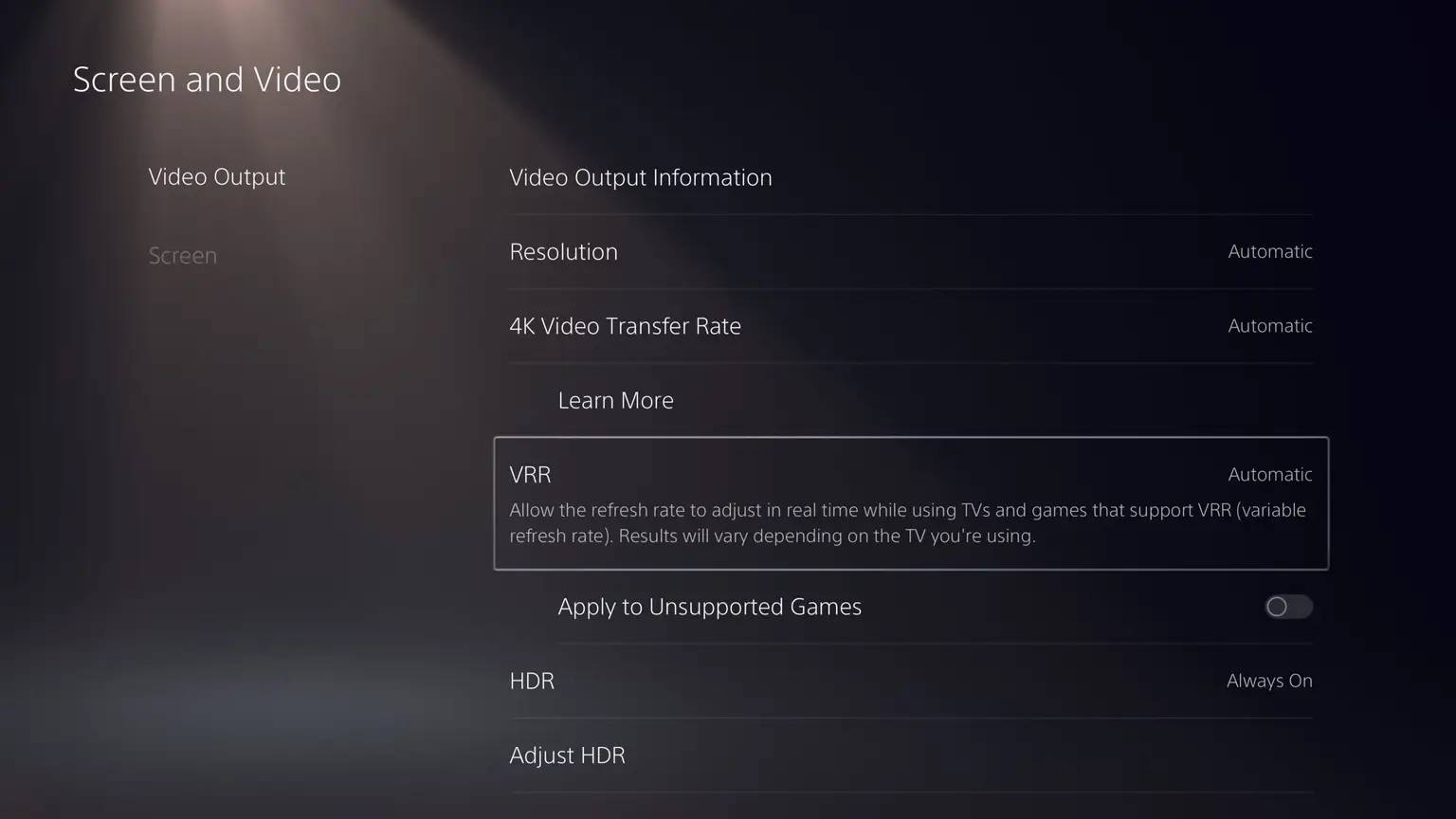
When PS5 VRR is available, though, it can be turned on by going into Settings and heading to the Video Output submenu within Screen and Video. The option can be toggled to on, off, or set to automatic, which will apply VRR straight away for all supported games.
Interestingly, Sony has also included a toggle to apply PS5 VRR to unsupported games. Not every game will receive a tailor-made patch to support VRR, but this option means you can brute-force variable refresh rate at a system level, which should hopefully benefits numerous unsupported PS5 and PS4 games.
Sony notes that enabling this option “may improve video quality for some games,” but also warns that unexpected visual effects may occur as a result. Either way, it’s fantastic to see that PS5 VRR won’t be limited to just a select few titles, even if those titles will likely perform better than unsupported ones. Of course, if you do encounter any odd visual anomalies when using this setting, you can always turn it off.
VRR is an exciting addition to PS5, then, and comes after Sony recently added auto low latency mode (or ALLM) to its console. The one omission from PS5’s display features that still stings, though, is the lack of 1440p support. Connect a PS5 to a 1440p monitor, and you’re stuck at 1080p, which means gamers are missing out on 43.75% more detail than they should be. With 1440p monitors being one of the most adopted display resolutions in the market, it’s a noticeable oversight from Sony that the PS5 can’t natively output games at this resolution.
Still, that doesn’t take the shine of PS5 VRR support, and we’ll be updating this guide with our full findings and compatible games when the feature arrives in the months ahead.
We continue to wait patiently for the arrival of the Google Pixel Watch, but according to the latest from the rumor mill we might have to hang on for a few months yet – it seems the wearable might not launch until October, alongside the Pixel 7 and the Pixel 7 Pro.
That's according to well-known tech tipster Jon Prosser on Twitter, who says that the smartwatch is going to be teased at the Google IO event in May before getting a full announcement and launch later on in the year.
Prosser – who has less than a 100 percent record with tech predictions – also says the Google Pixel 6a will be fully unveiled at Google IO, which runs from May 11 to May 12. That device is said to be going on sale on July 28.
Watch this space
The last we heard from Prosser, he was suggesting that the launch of the Pixel Watch – as in the date it would get properly unveiled and go on sale – was going to be pushed back from around Google IO time to later in the year. That has now come to pass.
It's the global chip shortage that once again seems to be to blame, with manufacturers across the tech industry scrambling to find enough components to put in their products. While the problems do seem to be easing, the effects continue to be felt.
We'll be watching closely when Google IO 2022 gets underway on May 11. Ostensibly an event for developers to learn more about Google's software platforms, it has occasionally been used to launch a hardware product or two in previous years.
Analysis: a gadget Google needs to get right
Take a trip through the TechRadar archives and you'll see that we've been waiting for the Pixel Watch for an awfully long time. It was at one stage expected to launch alongside the Pixel 3 and Pixel 3 XL back in 2018, for example – which obviously didn't happen.
Fitbit's acquisition by Google's parent company Alphabet, completed in 2021 – for a hefty $2.1 billion – gave new impetus to the Pixel Watch rumors. As yet though, we're still waiting for the flagship wearable to make its public debut.
Google seems to have refocused its efforts on Pixel hardware lately, specifically with the Pixel 6 and Pixel 6 Pro – devices that really give the best phones on the market something to think about. That's a good sign that the Pixel Watch could be here soon.
With the Apple Watch dominating the market and Samsung also boasting a strong smartwatch line-up, it's perhaps no bad thing that Google is taking its time: it needs to get the Pixel Watch right to make sure it's a serious competitor to what's already out.
The OnePlus 10 Pro is finally about to get its global launch. For those keeping track, it was first unveiled for China in January, then during MWC 2022 in February the company confirmed that it would land elsewhere in March, and now that time has almost come.
The official global unveiling is set for March 31, but of course there’s not much left to know, as the design and specs of the OnePlus 10 Pro have already been revealed.
There are still a few things that we’re waiting to learn though, and we’ve detailed them below.
1. The price
This is probably the biggest remaining question about the OnePlus 10 Pro – how much it will cost. We know that in China it starts at 4,699 Yuan, which is around $740 / £560 / AU$990, however we don’t expect exact conversions.
More useful might be the OnePlus 9 Pro’s price, as that started at £829 (about $969, AU$1,250) for 8GB of RAM and 128GB of storage. That model wasn’t available in the US though, where you could only get the 12GB / 256GB model, which cost $1,069 / £929 (about AU$1,400).
In any case, it’s possible that the OnePlus 10 Pro will have a similar price, but for now we really don’t know.
2. The release date
(Image credit: OnePlus)
We know the OnePlus 10 Pro is getting its global unveiling on March 31, and you can pre-order it from then, but that's not when it ships, and we're not yet sure what date that will be. It's likely to be at least a week later, and could be even longer.
So while you’ll probably be able to get it in your hands before too long, we don’t know exactly when yet.
3. The RAM and storage
Technically we do know the RAM and storage amounts for the OnePlus 10 Pro, or rather we know the amounts in China, but it’s possible that the configurations will vary a little elsewhere.
In China you can get a OnePlus 10 Pro with 128GB of storage and 8GB of RAM, 256GB of storage and 8GB of RAM, 256GB of storage and 12GB of RAM, or 512GB of storage and 12GB of RAM.
That’s quite a few different options so we wouldn’t expect any additional ones elsewhere, but it’s possible that some of those won’t be offered, or that only some regions will get some of them (just like how the US didn’t get as many configurations of the OnePlus 9 Pro as the UK did).
Even in the UK though you can only get the OnePlus 9 Pro with either 128GB of storage and 8GB of RAM or 256GB of storage and 12GB of RAM, so it’s possible that the OnePlus 10 Pro’s capacities will mirror that, but we just don’t know.
4. Whether we'll get the Extreme Edition
The OnePlus 10 Pro Extreme Edition(Image credit: OnePlus)
We mentioned the storage capacities above, but the top OnePlus 10 Pro storage capacity - the 12GB / 512GB one - is actually a special model dubbed the OnePlus 10 Pro Extreme Edition.
This comes in a Panda White shade, which the other versions aren't available in, but is otherwise the same phone.
So will we get the Extreme Edition globally or will we be limited to lower capacities and the choice of Volcanic Black or Emerald Forest shades? Right now we're not sure.
This website is made by Witnux LLC. This website provides you with all the news feeds related to technology from large tech media industries like GSM Arena, NDTV, Gadgets 360, Firstpost and many other such ates altogether at technical depicts so that you need not go to several sites to view their post provide you advantantage of time.
From the developer
Tanzeel Sarwar
OUR OTHER NETWORKS
OUR YOUTUBE CHANNEL
ROVE REVIEWS PLEASE SUBSCRIBE
OUR FACEBOOK PAGE
The Rove Reviews
Support
Trying our best to provide you the best DONATE or SUPPORTour site Contact me with details how are you gonna help us